Study figure and data
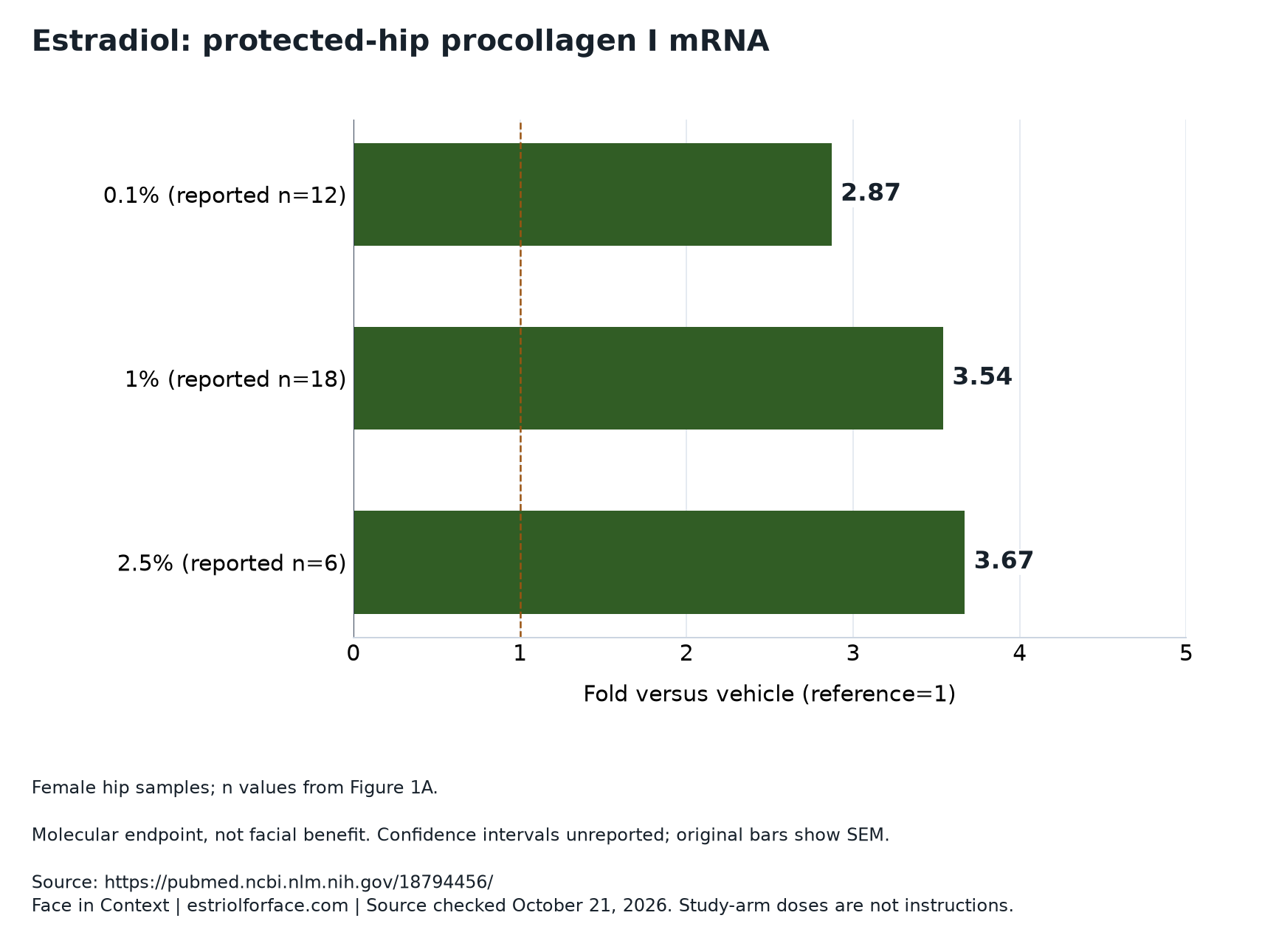
Estradiol: protected-hip procollagen I mRNA
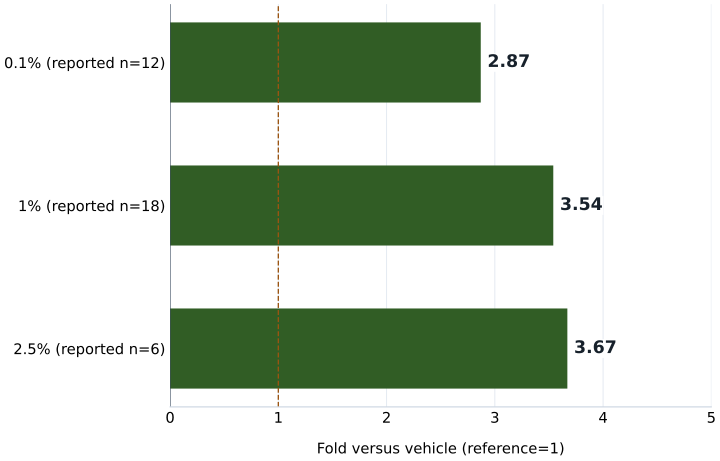
Female hip samples; n values from Figure 1A.
Molecular endpoint, not facial benefit. Confidence intervals unreported; original bars show SEM.
Download chart (PNG)Download data (CSV)Download vector chart (SVG)
| Historical estradiol concentration | Reported value |
|---|---|
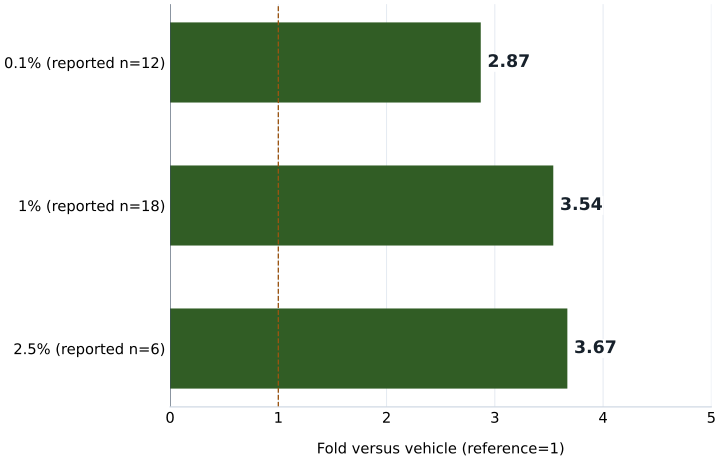
| 0.1% (reported n=12) | 2.87 |
| 1% (reported n=18) | 3.54 |
| 2.5% (reported n=6) | 3.67 |
What exactly is being compared?
Experiments included 70 adults averaging about 75 (40 women, 30 men): one-week paired hip/forearm vehicle comparisons; separate two-week facial comparisons, five women/five men.
A comparison has a unit as well as a headcount. In a hypothetical paired experiment, two sampled areas on one person are related observations. Calling them two independent participants would change the question the analysis answers. Likewise, a before-and-after comparison asks about change within the observed group, whereas a concurrent reference condition helps ask what might have happened without the ingredient. Neither description, by itself, establishes how the researchers assigned conditions. Randomization needs an explicit account of the assignment process.
Keep that structure attached to the result before reading the percentage on a formula label. A concentration names a proportion; it does not supply an exchange rate between different molecules or preparations. Our guide to keeping face, neck and body evidence separate offers another way to organize the anatomical part of this question. The table below is an editorial checklist, rather than a reconstruction of additional research arms.
| Item to identify | Question for the source | Evidence needed for a new claim |
|---|---|---|
| Ingredient | Which molecule was tested? | A justified connection to the proposed ingredient |
| Preparation | Which complete preparation was evaluated? | Documentation that addresses the changed formula |
| Comparison | What was the reference condition? | A comparison appropriate to the proposed conclusion |
| Outcome | What did the measurement represent? | Evidence addressing the outcome named in the claim |
How much can a ratio tell us?
A ratio answers a deliberately narrow mathematical question: how large is one quantity relative to another? Imagine a fictional laboratory result of six units against a reference of two units. The ratio is three, and the increase over the reference is four units, or 200%. Calling that a 300% increase would confuse the final level with the change. None of those calculations tells us whether a person would notice a difference in a mirror.
The reference also matters. Suppose a second fictional experiment reports twelve units against six. Its ratio is two, although its absolute difference is six units. Ranking the experiments by their ratios and ranking them by their absolute differences gives different orders. That is not an arithmetic inconsistency. It shows why a common unit, a common reference and a comparable measurement process are needed before combining results.
Messenger RNA carries protein-making instructions; measuring it differs from measuring protein. To evaluate a broader claim, write the intended endpoint in words beside the laboratory unit, then ask what study connects the two. Our reading guide for estriol research develops this habit of preserving the measurement through each interpretation.
Which uncertainty belongs beside a bar?
Figure 1A’s n=18 conflicts with Table 1’s 17; Figure 1B’s first protein concentration conflicts: caption 0.01%, narrative 0.1%.
When a paper contains conflicting entries, a transparent reading preserves both locations and keeps the disputed entry out of any calculation that depends on choosing one. An attractive graph does not resolve a documentation problem. For a reproducible extraction, record the figure, panel, row and wording used, then distinguish an unresolved discrepancy from a verified correction. Otherwise a later reader cannot tell whether a number was copied, inferred or silently repaired.
Uncertainty symbols require the same care. Standard error describes precision associated with an estimated mean; a confidence interval is a differently specified statistical summary. They should not be relabeled as one another. A chart without uncertainty bars may still display a reported point estimate, but the distance between two points alone cannot establish a statistically supported difference. Nor does a larger sample label make every possible comparison valid. Before calculating, specify the contrast, identify which observations are independent and check whether the information needed for its uncertainty is available.
Does a second measurement complete the argument?
Facial/forearm procollagen responses were nonsignificant despite activity in estrogen-response marker GREB1.
The word despite can tempt a reader to fill in a mechanism. A more useful method is to draw separate boxes for a molecular response, a structural measurement and an appearance outcome. Put an arrow between boxes only when there is evidence for that connection. An observation in one box may motivate the next experiment without telling us its result. This is a framework for reading a chain of claims, not a proposed biological explanation for the findings.
Consider a hypothetical experiment in which signal A changes and measurement B does not reach statistical significance. Several questions remain open: how precisely was B measured, how long was follow-up, and what size of change could the design distinguish? The result does not justify replacing B with A as the outcome of interest. Similarly, comparing observations from different anatomical locations does not isolate the reason for a difference if other conditions also differ. A causal explanation needs a design capable of separating those possibilities. Our guide to skin-care context helps keep the practical question visible while reading this kind of laboratory work.
What changes in a newer facial comparison?
A separate 2026 conference pilot randomized 90 postmenopausal women aged 50–60 to estriol 0.3%, estradiol 0.01% or placebo; 86 completed twelve weeks. Investigator hydration ratings improved against placebo; participant-rated efficacy did not differ. Estriol firmness conflicts between narrative and table (P=.077). Alloy Health funded the study.
Those details belong to a separate record, not an extension of another experiment. To compare studies, make a row for each design and a column for each question: population, preparation, reference condition, duration and outcome. A difference in any column may change what agreement would mean. Two studies need not report the same kind of number to be informative, but different numbers cannot be treated as interchangeable estimates of one effect.
A rating is a judgment expressed on a scale; a physical measurement has its own unit and procedure. Agreement between them would be a question to investigate, rather than something created by giving both the label hydration. The companion guide to facial estrogen evidence examines that distinction in detail. When comparing two active ingredients, also look for an actual comparison between them: separate comparisons against a reference do not, by themselves, establish which active ingredient is superior.
What do older comparisons add?
The indexed 1996 abstract describes 59 preclimacteric women receiving estradiol 0.01% or estriol 0.3% for six months, with biopsies in ten. It reports improvements but combines wrinkle-depth/pore-size reductions into 61–100%; separate estimates are unavailable. Prolactin increased. Randomization, blinding and vehicle control are not established by that abstract.
An incomplete numerical description can be useful without becoming a graph. First list the distinct outcomes named in the sentence. Then ask which number belongs to which outcome, how the change was calculated and which participants contributed. If the text supplies a range without those links, selecting its upper endpoint as a typical result creates information the report did not provide. An honest extraction keeps the unresolved mapping visible.
Subsets raise a second question: who contributed to each measurement? A laboratory assessment made in a subset cannot automatically describe everyone enrolled, and a total enrollment figure does not establish the denominator for every reported result. In an ideal follow-up report, a participant-flow diagram and outcome-specific denominators would let the reader follow exclusions and missing measurements. That would improve interpretability even before considering whether the result itself was positive or negative. Duration belongs in the same record: a longer observation period changes the question, but does not automatically resolve weaknesses in its comparison.
What is a blood result actually asking?
Facial 0.2% estradiol increased serum estradiol twelvefold in women, twofold in men. The 1993 indexed abstract, separately, reports no significant hormone or vaginal-smear changes in 17 women over three months: nine received estradiol ointment, eight estriol ointment.
These observations should retain their own preparations and participants. A blood concentration, a tissue observation and an adverse clinical event are different endpoints. The ability to detect one does not determine how precisely a study measures another. To interpret a blood result, useful questions include when samples were taken, what the assay could detect and how variable the measurements were. These are requests for measurement context, not reasons to invent an exposure estimate for a different product.
Nonsignificance is particularly easy to overread. In a hypothetical comparison, a wide interval that includes zero can also include changes that would matter. A carefully designed equivalence analysis instead starts with a justified range of differences considered acceptably small and tests whether the evidence fits inside it. Those are different questions. Similarly, evaluating uncommon events calls for an appropriate sample, follow-up and collection method; a laboratory comparison cannot substitute for that design. The consultation question guide can help organize questions without converting a research concentration into an application plan.
How would a follow-up answer the missing question?
Start by writing one sentence that names the proposed claim and its intended population. Then define an outcome that would answer that sentence. If the claim concerns an appearance change, specify who assesses it, the assessment conditions and what difference would be meaningful before examining the results. A laboratory endpoint may remain valuable as a separate explanatory question. Keeping the questions separate prevents a favorable secondary measurement from quietly replacing the original objective.
Next, make the comparison capable of addressing the claim. A reference preparation, assignment method, masking plan and follow-up schedule each solve different design problems. Specify how missing observations will be handled and which analyses were planned in advance. When many outcomes are examined, explain how that multiplicity affects interpretation. Finally, report estimates with uncertainty and denominators so that readers can judge both the size and precision of the observed differences.
The table is an editorial proposal for assessing a future report, not a description of a completed trial. It also identifies what evidence would be useful when the molecule or preparation changes. A study can answer its own question well while leaving the new question unresolved; designing the next comparison is more productive than treating that gap as either a guarantee or a dismissal.
| Proposed claim | Design question | Reporting question |
|---|---|---|
| Visible change | Which assessment directly addresses appearance? | What size of difference was observed, with what uncertainty? |
| Ingredient comparison | Were the active ingredients compared directly? | Which contrast was prespecified and estimated? |
| Formula transfer | What changed in the preparation? | Which documents and data address that change? |
| Safety question | Which event or measurement was the study designed to assess? | How were timing, missing data and follow-up reported? |
Which claims belong on a separate evidence sheet?
FDA states that no estriol-containing drug has approval. Compounded medicines are not FDA-approved and do not undergo FDA premarket review for safety, effectiveness and quality; they are not approved generics.
Regulatory status, a research finding and an offer’s terms answer different questions. Put them on separate lines so that one does not serve as a substitute for another. A scientific citation should identify the work supporting the scientific statement. Formula documentation should identify what is actually being discussed. A regulatory statement should be checked against the relevant official source, without treating a facility description or a brand name as an approval decision.
For an editorial comparison of offers, the CoreAge Rx review and Musely review provide places to examine the documentary questions. Linking them here does not establish a match to any experimental preparation. Record the exact wording of the claim you want to investigate, identify the document offered in support and check whether it addresses the same ingredient, formula and outcome. If those identifiers are missing, a more detailed request for documentation is the next analytical step. It is not necessary to infer a provider’s results from the existence of a citation.
Who conducted the work, and what remains checkable?
Pfizer partly funded research; Voorhees disclosed Pfizer consulting.
Funding and disclosures belong beside the methods because they help readers evaluate the research context. They are not a shortcut for accepting or rejecting a numerical result. A useful appraisal asks whether the protocol, analysis plan, denominators and complete outcomes can be checked, and whether independent work asks a sufficiently similar question. A company’s involvement also cannot, without further documentation, connect an experimental preparation to a current commercial formula.
Access matters for the same reason. An indexed abstract can provide a concise account while leaving questions that require the complete paper. Mark the question as unresolved at the level actually examined. Do not turn an absent detail into a claim that the researchers omitted the procedure, or assume that unavailable funding information means no funding. A reader should be able to distinguish what was reported, what was checked and what remains unknown.
The most useful next evidence is therefore specific: a missing denominator, a clarified figure label, a direct active comparison, a validated clinical endpoint or a documented preparation match. Each would repair a different gap. This approach gives both encouraging observations and unresolved results a clear place in the record without asking either to carry a conclusion beyond its measurement.
Questions about the evidence
Does the largest concentration identify the best ingredient?
No ranking follows from the label alone. Concentration describes a proportion within a preparation. A comparison of clinical performance needs appropriate data about the ingredients and formulas being compared, with the intended outcome defined. A concentration ratio is not a validated conversion between molecules.
Can a laboratory ratio be converted into a wrinkle percentage?
Only a justified relationship between those measurements could support that conversion. Arithmetic can describe a change in the measured quantity, but it cannot create a relationship to a different outcome. Ask for the study establishing that connection before assigning an appearance percentage.
Should an unresolved figure label be corrected in a review?
Preserve the reported entries and explain the discrepancy. A review can identify the question for clarification, but choosing a preferred entry without evidence hides uncertainty. Any later correction should state its source and keep the earlier extraction understandable.
What would make two studies a useful comparison?
Begin with the question each was designed to answer. Compare the population, preparation, reference condition, follow-up and endpoint. Then decide which similarities support a shared interpretation and which differences require separate treatment. Matching a keyword in the titles is only the starting point.
Can this reading framework decide whether a cream is suitable for me?
It can organize the evidence and identify unanswered questions, but it does not establish individual suitability. Keep the scientific question distinct from a clinical assessment of personal circumstances and from the practical terms of an offer. Bring specific uncertainties into the appropriate clinical discussion.
Editorial assessment
Our editorial assessment is to carry the comparison forward one item at a time. Preserve the ingredient and preparation, identify the reference, read the actual endpoint and retain its uncertainty. When the proposed claim changes any of those items, name the additional evidence needed. This makes it possible to learn from a laboratory experiment without converting it into a product verdict. It also makes future updates more useful: a new report can address a defined missing connection, and readers can see exactly which part of the interpretation has changed.
Research access and limitations
This is public-source editorial interpretation, not a clinical assessment or product test. Historical research conditions are discussed for identification, not as directions for use. Access notes distinguish the materials examined; unresolved questions remain attached to the specific records rather than being filled with assumptions.