Study figure and data
Facial estrogen pilot: hydration ratings
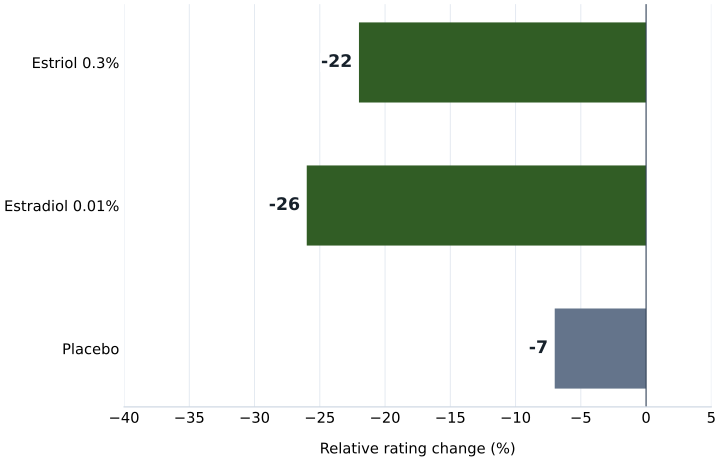
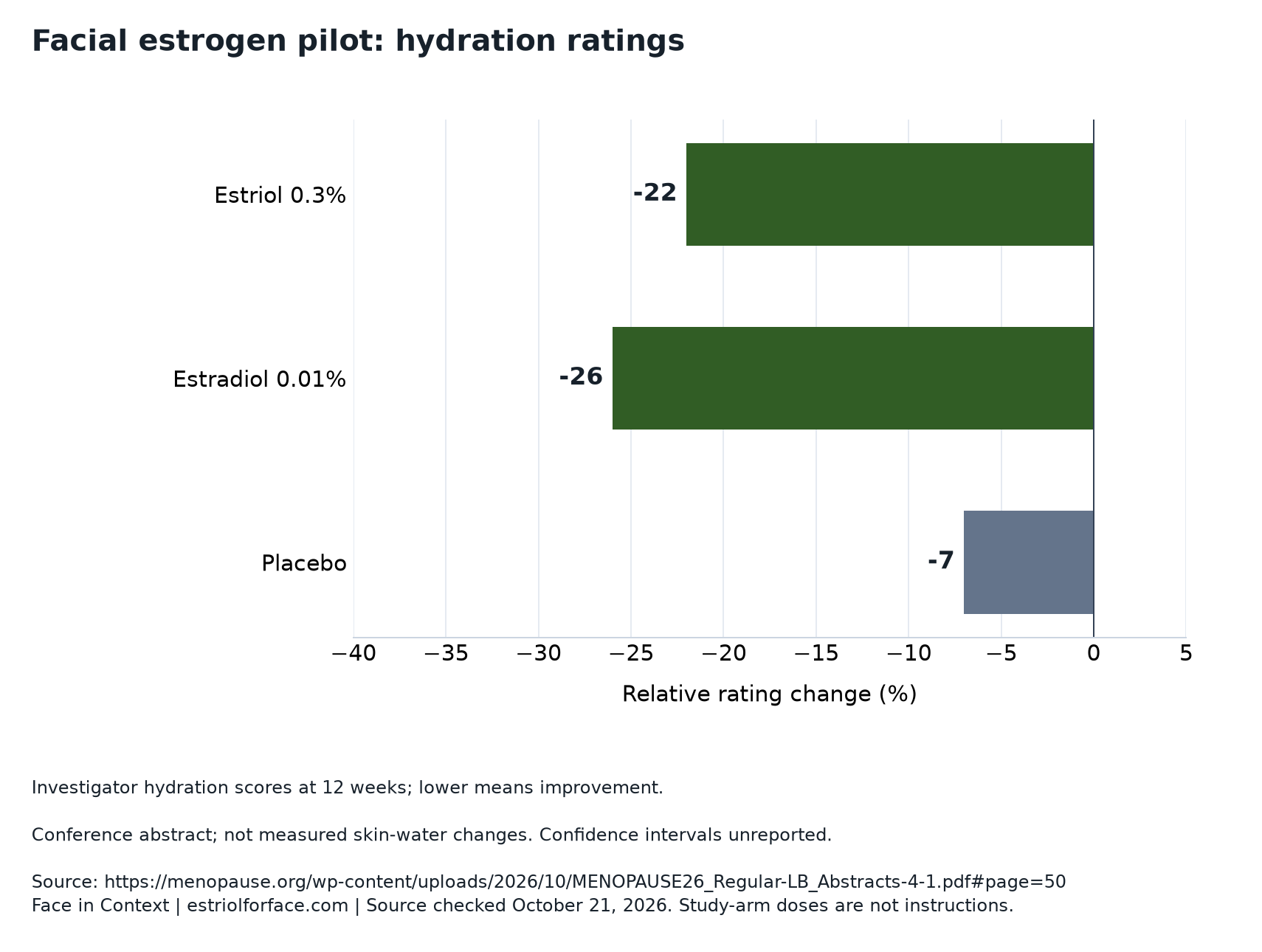
Investigator hydration scores at 12 weeks; lower means improvement.
Conference abstract; not measured skin-water changes. Confidence intervals unreported.
Download chart (PNG)Download data (CSV)Download vector chart (SVG)
| Historical cream arm | Reported value |
|---|---|
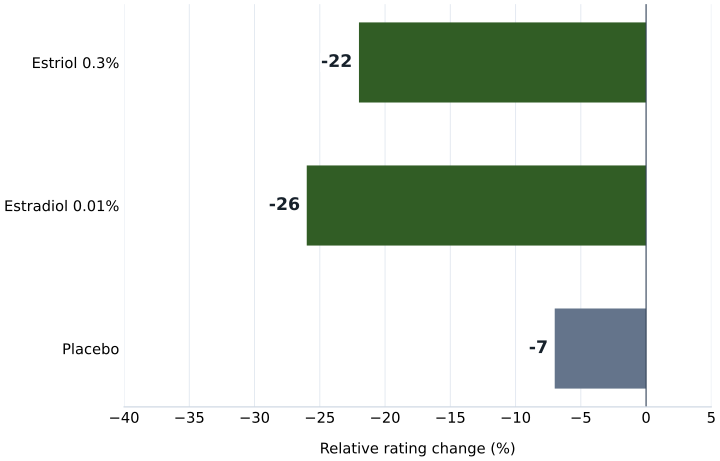
| Estriol 0.3% | -22 |
| Estradiol 0.01% | -26 |
| Placebo | -7 |
Which identity needs to stay attached?
P-124 is a preliminary randomized, double-blind, single-site conference study: 90 postmenopausal women aged 50–60, 30 per arm, 86 completed.
Those design terms answer different questions. Random allocation describes how groups are formed; it does not mean the volunteers are a random sample of everyone considering treatment. Blinding addresses knowledge of assignment, while a comparison group addresses what happened under another assigned condition. As an original reading method, give each feature its own line in a study note. This prevents one reassuring word from standing in for the entire design.
Next, separate the ingredient name from the preparation. A hypothetical cream and a hypothetical ointment could share an ingredient name while remaining two different objects to investigate. Calling them the same would skip a step in the argument. The needed evidence would connect the actual preparations, rather than merely repeat the name. Our guide to combination formulas is a place to organize that question. The table below is an editorial worksheet: it describes information to seek, rather than asserting that any commercial formula matches a study. Keep the original wording of each identity field until the connection has been documented.
| Identity field | Question to record | Evidence needed for a transfer |
|---|---|---|
| Ingredient | Which substance is named? | A comparison involving the proposed substance |
| Preparation | What complete formulation was tested? | A documented match or a relevant bridging study |
| Population | Who was eligible for the comparison? | Evidence applicable to the proposed population |
| Measurement | What counted as the outcome? | A justified connection to the claimed benefit |
What does a rating percentage measure?
Investigator ratings used 0–4; fine-line, wrinkle, pore, tone and participant efficacy comparisons were nonsignificant.
A rating scale places observations into ordered categories. Its numbers label those categories; they are not automatically physical units. Consider a completely hypothetical score changing from 2 to 1.5. The numerical change is minus 0.5, and dividing that change by the starting value gives minus 25%. That calculation describes a relative change in the score. It does not show that a quarter of the people improved, that a quarter of wrinkles disappeared, or that a physical property changed by a quarter.
The starting value matters. In another invented example, the same half-point decrease from a starting score of 1 would produce minus 50%. Identical absolute score changes can therefore generate different relative percentages. This is why a useful interpretation asks for both the scale and its starting distribution. An additional question concerns aggregation: a percentage computed from group summaries need not equal the average of individual percentages. Without a specified calculation, do not quietly choose one. A chart becomes easier to read when its label is treated as part of the result, rather than decoration around an otherwise self-explanatory number.
Which comparison would establish a difference?
Imagine a separate, invented experiment in which group A improves by 18% and group B by 12% on the same score. Their displayed changes differ by six percentage points. Calling that a 6% advantage would leave the denominator unclear; calling it a proven advantage would add a statistical claim that the subtraction alone cannot supply. An actual comparison needs an analysis of the difference, with uncertainty around it.
A comparison of A against a reference group asks a different question from A against B. Even if each treatment is tested against the reference, those tests do not automatically settle the comparison between treatments. Nor does one comparison crossing a significance threshold while another misses it demonstrate that the two treatment effects differ. The quantity of interest is the contrast between the effects, not the contrast between two labels attached to separate tests.
This distinction is especially helpful when ingredient names attract attention. Write the proposed conclusion as a question first: better on which measurement, compared with what, at what time? Then locate the analysis that answers that exact question. If the analysis is absent, the correct next step is to request it. Reordering the bars or comparing the visible lengths cannot create a missing comparison.
How much uncertainty belongs beside a point?
Multiplicity handling, analysis set, arm-specific attrition and ± definitions are unreported.
An estimate is one location on a numerical scale. An uncertainty interval would show a range of values compatible with a specified analysis; a significance test alone is not a replacement for that range. In a hypothetical report, two estimates of the same size could have very different precision. One could come with a narrow range and the other with a broad one. Displaying only the common point would conceal that distinction.
Missing observations introduce a separate question: which participants contributed to the reported result? Imagine an invented study with several people absent from a final assessment. Calculating only from those present and assigning outcomes to everyone originally allocated are different analytical choices. Neither can be reconstructed from a single total. A useful follow-up asks how missing values were handled and whether alternative assumptions altered the conclusion. Finally, several measured outcomes create several opportunities to find an apparently promising result. The reader needs to know which question was planned as central and how the collection of comparisons was handled. That information determines the strength of the inference; it is not a cosmetic addition to a graph.
What happens when the summary and table disagree?
Estriol firmness conflicts: narrative positive; table P=.077. Objective water: estriol P=.042; estradiol P=.061.
A disagreement between two parts of a report should remain visible. The editorial task is not to pick the more attractive statement and erase the other. Instead, identify the disputed outcome, preserve the table entry and seek a clarification. That approach also keeps the disagreement local: a problem with one claim does not, by itself, tell us that every other measurement is wrong. A P value concerns how unusual data would be under the test’s specified no-difference model and assumptions. It is neither the probability that a treatment works nor a measure of the size of its effect.
Related labels can produce a second reading error even without an internal contradiction. A subjective rating, a participant judgment and an instrument reading can all concern a similar topic while describing different observations. Imagine an instrument detecting a small physical difference that a person does not notice, or a person noticing a change that an instrument was not designed to capture. These are hypothetical possibilities, not explanations of the present data. They show why the assessment method must accompany the endpoint name. To interpret agreement or disagreement, a fuller report would need to establish what each method measures, how consistently it measures it and what amount of change is meaningful. A shared topic word is not enough to merge results.
Can a tissue experiment answer an appearance question?
The JAMA experiments enrolled 70 across sites; the separate facial group comprised five women and five men for two weeks. Facial procollagen responses were nonsignificant. Figure 1A n=18 conflicts with Table 1 n=17; Figure 1B first protein concentration conflicts: caption 0.01%, narrative 0.1%. Pfizer partly funded research; Voorhees disclosed Pfizer consulting.
A molecular measurement and a visible appearance judgment occupy different positions in an argument. Messenger RNA is a genetic message; counting a message is different from measuring the resulting material, its organization, or a visible outcome. An original way to examine a proposed connection is to draw separate boxes for these measurements. Each arrow between boxes represents evidence that would be needed, rather than a result that can be assumed.
The same discipline applies to anatomical location. A finding in one location could motivate a question about another, but the question itself is not an answer. Differences between locations also leave multiple possible explanations to investigate; they do not identify a cause simply by being different. The companion collagen analysis examines that distinction in detail. Read it alongside the face, neck and body guide when deciding which identity fields a proposed comparison would change.
What do the older comparisons add?
The indexed 1996 abstract describes 59 preclimacteric women, two active compounds and six months; biopsies involved ten. Randomization, blinding and vehicle control are not established. Combined wrinkle/pore percentages lack separate estimates. Prolactin increased significantly; systemic hormonal side effects were not noted. Funding is unknown from this abstract.
An active-versus-active comparison can help ask whether two assigned approaches differ, provided its design and analysis support that inference. It cannot automatically identify how much of a shared change would also occur without either active ingredient. A vehicle comparison asks a different question by retaining the preparation framework while changing the active treatment. A before-and-after observation asks a different question again. These are distinctions in the logic of comparison, not a ranking based solely on publication age.
A smaller biopsy subset adds another layer: a tissue observation may concern fewer people than the wider clinical assessment. To connect the results, a reader would need to know how that subset was selected and whether the measurements can be linked within individuals. A dramatic combined range is particularly difficult to interpret when it bundles outcomes. The table below offers an original extraction method for preventing that bundle from becoming a single imagined effect.
| Part of the report | Separate question | Useful clarification |
|---|---|---|
| Outcome label | Is this one measurement or several? | A distinct estimate for each endpoint |
| Participants | Who contributed to this result? | An endpoint-specific denominator |
| Comparison | What is the reference condition? | An explicit definition of the contrast |
| Uncertainty | How precise is each estimate? | An interval and its calculation method |
What would make an exposure result reassuring?
The 1993 indexed abstract covers 17 women: nine estradiol, eight estriol, three months. Serum hormones and vaginal smears showed no significant change. Randomization, blinding and vehicle control are unstated; funding is unknown from this abstract.
A failure to detect a difference is a statement about an analysis, not a measurement of exactly zero. Establishing equivalence would require specifying an acceptable difference and testing the data against that boundary. A small comparison with uncertain precision can leave meaningful differences unresolved even when its significance test is negative. Likewise, a laboratory result answers a question about the sampled measurement; it does not count every possible clinical outcome.
Useful exposure questions concern when samples were obtained, what the assay could detect, and whether the reported summary conceals variation between people. Useful safety questions additionally concern which events were actively sought, how long participants were observed and how completely follow-up was obtained. Those questions distinguish evidence of a measurement from evidence about a risk. They can be brought to a professional discussion without turning a historical research schedule into instructions. The consultation question guide can help organize the record of what is known and what still needs an individual clinical assessment.
Where do funding and regulatory status fit?
P-124 reported nonsignificant serum comparisons and no tolerability-scale issues; Alloy funded. FDA reports no approved estriol-containing drug; greater estriol safety is unestablished. Compounded medicines lack FDA approval and premarket review for safety, effectiveness and quality; they differ from approved generics.
These statements belong in different columns of a reading record. Funding identifies a documented relationship. It neither substitutes for inspection of the methods nor establishes that a current retail preparation is the studied intervention. Regulatory status answers another question altogether. An editorial assessment should preserve those distinctions instead of using one fact to settle every question about identity, effect or suitability.
For a hypothetical product-to-study connection, request the relevant formulation documentation and the actual evidence supporting that connection. An organization name is not a formula specification. A shared highlighted ingredient is not the full preparation. The FDA context guide helps separate terminology. The Alloy review and CoreAge Rx review are documentary reading paths for examining their respective offers; these links establish no match to a trial intervention. This is an editorial approach to checking claims, not a determination that a particular preparation is appropriate for a particular person.
What would the next useful study need to connect?
A useful research proposal begins with a precise unresolved question. If the uncertainty concerns a formulation, identify the exact preparation and its comparator. If it concerns whether a measured change matters to people, define both the measurement and a meaningful outcome before collecting data. If it concerns durability, specify the follow-up needed to observe persistence. These are different projects, even when they share an ingredient name.
The analysis plan should then follow the question. Prespecify the primary comparison, describe how missing observations will be handled, and plan reporting that includes estimates with uncertainty. Distinguish a hypothesis-generating signal from a result designed to test a particular hypothesis. Keeping that distinction explicit makes a promising early observation useful without asking it to do the work of a larger program.
Finally, write down what would change your conclusion. A documented formulation match might resolve one identity gap while leaving an outcome gap open. A precise estimate might resolve uncertainty about the size of an effect while leaving its relevance unsettled. This is a practical way to move beyond a yes-or-no reading of research. Each new piece of evidence should answer a named question and update that part of the argument. The complete chain becomes more informative because its individual links remain inspectable.
Questions about the evidence
Does a larger concentration number identify the better option?
No ranking follows from the printed percentages alone. As a reasoning check, ask whether the comparison holds the substance, preparation, measurement and population constant. A numerical label is an identity detail. Establishing comparative benefit requires the relevant outcome comparison; it cannot be obtained by dividing one label by another.
Can I read a change in a rating as a response rate?
Only when the report actually defines and reports a response rate. A response rate needs a rule for deciding who counts as a responder and a denominator of people. Arithmetic on a score uses a different denominator. Keep those two calculations separate before interpreting a percentage.
Would a negative comparison settle a safety question?
First specify the safety question and the difference that would matter. Then examine whether the measurements, sample and observation period could address it with useful precision. A statistical label cannot replace that reasoning. The appropriate conclusion follows the question studied, rather than every possible concern a reader might have.
How should a reader handle an unresolved table discrepancy?
Keep both entries attached to their locations, state that they disagree and avoid creating a reconciled number without evidence. A clarification could change the interpretation of that detail. Until then, a careful reading can discuss unaffected measurements while leaving the disputed mapping open.
What information is most useful when discussing a particular formula?
Bring the exact product description, the specific claim being evaluated and the research record used to support it. This creates a concrete comparison for a clinician to assess. An ingredient name or a broad promise alone makes it harder to identify which evidence would answer the question.
Editorial assessment
The most useful reading keeps a result attached to its complete question. Name the preparation, identify the comparison, preserve the measurement and inspect the uncertainty before considering a transfer. A promising observation can justify more research without resolving every link between an ingredient and a particular facial outcome. Our editorial approach is to make those links explicit: record what the evidence directly addresses, identify the additional comparison a claim would require, and leave unresolved details visible. That produces a clearer basis for a professional discussion than a ranking built from isolated percentages.
Research access and limitations
Evidence access: P-124 abstract/table; JAMA full article; indexed 1996 and 1993 abstracts; official FDA pages. Historical concentrations identify research conditions, not application instructions. No clinical review, personal treatment recommendation or retail-product equivalence is asserted.